Showing posts with label math. Show all posts

Sunday, October 23, 2016

How To Help Your Child Avoid Making "Silly Mistakes"

Every October and November, I start getting phone call after phone call about math. So many parents call us because their child is struggling in math. September is sorta like the honeymoon stage for math; most of it is a review of skills, and the class always seems deceptively easy. October is about the time that the grades start to plummet, and that's when the calls start rolling in.

One thing that I hear all of the time is, "My child just makes lots of silly mistakes on tests. S/he does well on the homework, but it's like s/he bombs the tests." After doing this for 4 years now, I've come to realize that it's more than silly mistakes. 

A silly mistake is when you do something incorrectly that you almost always do correctly. You may have added something incorrectly, or mistaken a 9 for a 4, but the mistake should be out of the ordinary and easily recognizable and fixable by the student. If it's a mistake that continues to happen, or if the student does not recognize their mistake, there's something else happening.

Math is logical, follows a predictable set of steps, and makes sense. When students don't understand how the steps work together, or don't have a general roadmap of what they're doing, they make all kinds of mistakes. More often than not, it's usually something simple. The tough part, however, is getting them to remember that "lost" step. 

Let me share an example with you. Last week, I was working with a seventh grader on rational numbers. Rational numbers is a big scary math word that means any number that can be written as a fraction. This includes fractions, decimals, and integers. Are you half asleep yet?

Here's the fun part. Most students forget one step or concept during a problem that gets them all mixed up. This student was forgetting to simplify her answer, so she was being marked wrong if her answer was not in simplified form. She used to HAAAAATE fractions, so she's really proud of herself when she finishes a problem. And who am I to remind her, after every problem, that it's wrong, again? Last week, I told her that instead of me reminding her to check her answer after every problem, she was going to remind herself. We used a post-it note to cover up the next problem so that she would be forced to move the post-it, and therefore READ the post-it, before moving onto the next problem:


She liked it because she felt in control of her own work. And she EVEN told me that she liked having it because she could use it on her other homework assignments when I wasn't around to remind her. I've always loved post-it notes, but this just tops it for me.

What do you do with your post-it notes?

Math Monday: ONE Question To Ask Your Kids When They Ask For Help

Whether your school-aged "kids" are your biological/adopted children or the students in your classroom, there's a good chance that they've asked you for help with a math problem. It's easy to give them the correct answer or help them figure out the first step, but doing so helps our kids become dependent upon us.

Every school year, I choose a new math mantra to practice with my kids. This year, I've chosen to focus on "PERSEVERANCE" for math. The new Common Core Standards have 8 mathematical practice standards that all students will master as they work through content. Here are a few that correspond to perseverance:

MP.1: Make sense of problems and persevere in solving them.
MP.3: Construct viable arguments and critique the reasoning of others.
MP.4: Model with mathematics.
MP.5: Use appropriate tools strategically.

Before students can solve a problem, they need to UNDERSTAND what that problem is asking them to do. In multi-step problems, some students read the problem once and then ask for help because they don't immediately see the arithmetic that is needed to solve the problem. Today's students are used to Googling questions, asking Siri, or texting friends if they get stuck. It's important for us to teach them HOW to work through problems that aren't easily solved. Students must be able to understand the problem, solve it, defend their steps/reasoning, and use that understanding to critique others. Students should be able to use models (tallies, pictures, diagrams, tables, etc) to help them explain their reasoning, and become more efficient when using these tools to solve problems.

With all of that being said, here are the 6 steps I am using this year to help my kids persevere through difficult math problems:

1. Have a positive attitude.
Having a positive attitude is a necessity. Many students that have not built up math stamina have a hard time entering a difficult task with a positive attitude. Help them by having them repeat positive affirmations, such as ,"I will try my best," "I can learn anything," "I'm making the decision to try," "I can do it," and "I believe in myself."

2. Read the problem, write an answer sentence, and read the problem again.
Have the student read the problem aloud. Ask them to locate the sentence that asks for an answer OR the sentence that asks a question. Using that sentence, write a sentence farm that answers the question, and use a line where the answer will go. For example, the last sentence of a word problem that asks, "How many flowers does Sophia have?" would turn into a sentence frame that says, "Sophia has __ flowers." Some students don't complete all of the steps for completing a multi-step problem, so writing this frame helps them figure out whether or not they are done solving the problem.

3. Underline/circle important information.
Help students read through the problem to look for information that helps fill in the answer frame. Students might circle numbers and key words, such as "altogether" or "how many more." Use the key words to help students figure out WHAT to do WITH the numbers. 

4. Try different strategies.
Students build mental toolboxes of strategies in school that they can use to solve problems, such as drawing a picture, using tallies, making a diagram, using manipulatives, and making tables. Encourage your kids to try different strategies if the one they're using isn't helpful.

5. Ask for help.
Some students skip step 1, complete part of step 2, and then jump straight to step 5. The BEST thing that you can do to is ask your kids the following question:

"What have you tried so far?"

It sounds simple, but it serves 3 purposes. First, it helps you see whether or not your student has worked through any strategies on their own. If they have, they should be able to tell you what they were. Make sure you praise them for any work already attempted on their own, especially for students with low math confidence. If they haven't, it will remind them that they need to go back and try some strategies on their own. Second, it helps students explain their work so far. Sometimes, explaining their work helps them redirect their own thinking. Third, it helps you understand where they got stuck. They may have copied down a problem wrong, used a strategy that isn't appropriate for the problem, or computed the wrong arithmetic.

6. Fill in your answer frame and check to see if it's reasonable.
It's so important to check answers for reasonableness. If a problem is asking for the difference between 2 numbers, the students should not end up with a number greater than the largest number in the problem.

Our kids will all be challenged with difficult problems this year, so make sure you encourage them to work through these problems. Be sure to ask them what they've already tried before offering any assistance to help them build up their math stamina.

Happy problem solving!

Thursday, November 13, 2014

Fall Workshops: Math Potholes: Multiplication

This is the time of year that we hear lots of parents stressing about math facts. In Long Beach, students in grades 2-5 are required to answer at least 65/70 facts correct in under 10 minutes (approximately 9 seconds per fact). In order for a student to receive a 4 on their report cards, they must be able to answer 68/70 facts correct in under 5 minutes (approximately 4 seconds per fact). This does not leave room for students to use aides, such as their fingers, a multiplication chart, or pictures. To help students pass these benchmarks, we use several different strategies.

First, we look at the four different ways that we can show multiplication using pictures. Here's an example:

Source: Natalia Ginns

Then, we show students how they can use a multiplication chart to help them when they get stuck. This is a nice visual for three main reasons. 1) It's easy to find patterns in a multiplication chart that help you remember some of those tricky facts. 2) When students use it, we have them circle the product that they got stuck on so tha we can keep track of their "hard" facts. 3) We like to show students how the chart can be folded in half, demonstrating how there are only half as many facts to memorize.

Source: Guru Parents
Once we feel that students understand what multiplication is and how to represent it visually, we shift gears into multiplication memorization. We have all sorts of tricks for memorizing facts, and a variety of ways that students can practice them and drill themselves. One of our favorites are multiplication wheels.

Source: Practical Pages

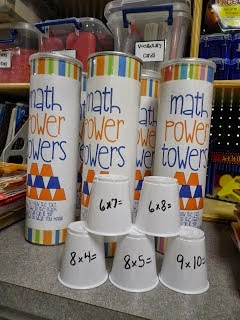
Another favorite is math towers.

Source: Teacher Tipster
If you missed our post abut our math facts Jenga, you can view that post here.

We can't wait to help your students memorize those facts!

Tuesday, June 3, 2014

Summer Workshop Schedule and FAQ

We've got lots of you asking questions about our group workshops this summer, so we thought we'd compile a list of your most frequently asked questions. You can also view this information on our website by clicking HERE. If you have any additional questions, don't hesitate to contact us! Here's a look at our schedule this summer:


How do I sign up for a workshop?
To enroll your student(s) in a workshop, click on our workshop page for the grade span that you are looking for (clock here for elementary school, here for middle school, and here for high school). Find the workshop that you'd like to enroll in, and click on the icon for that workshop. A window will pop up that will allow you to select the sessions that are available. For our four week sessions, there will be 2 date spans to choose from. For our nine week sessions, there will only be one. Once you've selected your dates, click "enroll". Repeat this same process for every workshop that you'd like to enroll in. Once you've added all of your workshops, click on the black "tuition" button on the upper right part of your screen. This will take you to a PayPal screen, which gives you the option to securely pay using your PayPal account, a debit card, or a credit card. Once we receive your payment, we will contact you to answer any other questions you might have.

How come some of the workshops are 4 weeks, and others are 9 weeks?
Our four week workshops are designed to give students academic support and enrichment without committing to workshops for the entire summer. We offer a wide variety of workshops that (hopefully) appeal to everyone's interests and schedules. Our nine week workshops run throughout the summer so that we can really dive into some amazing curriculum.

I love this workshop, but it doesn't work with my schedule. What are my options?
If you see a workshop that you LOVE, but it doesn't work with your schedule, shoot us an email and let us know. We'll try our best to find a time that works for you and fill it with other students. If you know of three other students that would like to join you, we'll give you a 20% discount on your enrollment. Contact us for more details!

Why is there such a wide grade span for some of these workshops?
Within a grade-level classroom, there are always students with different abilities. Some students in third grade are at a second grade reading level, while others are at a fourth grade reading level. Some second graders have mastered multiplication facts, while some fifth graders struggle with subtraction facts. The curriculum and activities that we have planned for each workshop are developmentally appropriate for the grade levels indicated. We like to offer our students a variety of workshops to choose from, and combining grade levels with similar abilities allows us time to offer more workshops. Once students begin to enroll in our workshops, we take a look at the students, their abilities, and their interests, and we tailor our workshops to them. In our science workshops, for example, we have several activities that we love doing with students. If we end up with mostly primary students, we use the activities that are best suited for them. If we end up with a wide variety of grade levels, we can bring in another instructor to break the workshop into 2 smaller groups. You'd be surprised, though, to see how excited students are to work with older or younger students. In our workshops, grade levels are just a number. We can promise you that we will work hard to ensure that your student, regardless of their abilities, will participate in activities that are appropriate, meaningful, and interesting.

How many students are in each workshop?​
We will only enroll up to 8 students in a workshop, but we will offer a workshop with as few as 3 students enrolled.

Group Workshop Frequently Asked Questions
Here are some of the questions we get asked most frequently about our workshops. If you have additional questions, don't hesitate to call us. We are here to help, and we'd love the chance to help you select the workshop that's just right for your student(s).

Will any of these workshops be available again?
I'm a paragraph. Click here to add your own text and edit me. It’s easy. Just click “Edit Text” or double click me and you can start adding your own content and make changes to the font. I’m a great place for you to tell a story and let your users know a little more about you.​

Can I enroll my student(s) in workshops that meet back-to-back?
Yes! Our summer workshop schedule is designed to offer back-to-back workshops. We have snacks and water bottles available to all students free of charge, and we offer lunch for an additional fee to students on Mondays from 11:30 am-12:00 pm, Wednesdays from 11:30 am-12:00 pm, and Thursdays from 12:00 pm-12:30 pm. If your student is enrolled in our K-1 Bookworms, K-2 Math Potholes, Addition/Subtraction Stacks of Facts, Seven Habits of Happy Kids, 4-5 Bookworms, and/or Multiplication/Division Stacks of Facts workshops, you can purchase lunch for them before, between, or after their workshop(s) during the times stated above.

What happens if we have to miss one of the workshop sessions?
If you are able to give us at LEAST 24 hours notice, we can try to work with you. For our four week sessions, you can attend one workshop (of equal or fewer minutes) in another session. For our nine week sessions, you can reschedule one thirty minute one-on-one session with the instructor. Unfortunately, we are not able to offer any refunds or reschedules of any kind if we do not have 24 hours notice. Please double check your calendars for vacations, family events, and any other potential conflicts BEFORE enrolling in a workshop.

Do your four week workshops repeat the same curriculum and activities?
Each four week workshop will have different curriculum and activities. For example, if you have a child that is really interested marine biology, each four week workshop will be different. We'd love to have your students join us for both workshops!

How will my first grader learn appropriately while in the same small group as a fifth grader?
It might help to think of our workshops as exercise classes for your brain: when you take a group fitness class, the instructor gives you modifications for beginners and for more advanced athletes. Our workshops are designed in a similar manner. Students use many of the same strategies when they read. First and fifth graders both read to find the main idea and supporting details, but they do so with texts at different reading levels. For our reading workshops, we are able to teach the same strategies as a group while allowing students to read and practice them at their own level. If there is a large discrepancy in abilities within one workshop, we can bring in another instructor to split the group up. The new Common Core math standards are scaffolded so that each standard increases in depth and complexity as students progress through different grade levels. We've noticed that ALL students, regardless of grade level, are really struggling with explaining and proving their mathematical reasoning this year. Our potholes workshops are designed to give students strategies and practice with this task. We can easily have all students work with geometric shapes at the same time. Our first graders might be counting faces and vertices, while our fifth graders might be making geometric nets.

My 6th grader still needs help with basic math facts. Can he enroll in a younger workshop?
If you have a student that needs (or is interested in) a workshop that is outside of the grade levels, give us a call so that we can help you decide what the best fit is. In LBUSD, students need to be proficient in addition and subtraction facts by the end of second grade, and proficient in multiplication and division by the end of fourth grade. If students to do not meet these benchmarks, they will be recommended for retention UNLESS they have an IEP or a 504. If you have a student in 6th grade that that struggles with math facts, our one-on-one instruction might be better suited to accommodate his needs than a group workshop. IF YOU HAVE A STUDENT THAT IS INTERESTED IN A WORKSHOP THAT DOES NOT INCLUDE HIS/HER GRADE LEVEL, PLEASE LET US KNOW SO THAT WE CAN SET SOMETHING UP.

I see the book club is for 6th-8th graders. My child is entering 7th grade but reads at a 5th grade level. Will books be chosen for their reading level or their grade level?
Our book club books are chosen according to their grade level. We have a few books in mind, and we will post the titles, as well as the reading levels, on our website once they are set in stone. We recommend choosing a book club that is for their reading level, therefore I'd recommend the Bookworms 4-5 workshop for your 7th grader.

Do students just practice flashcards in your math facts workshops?
No! Most students that struggle learning math facts have already tried using flashcards. In our math facts workshops, we focus on finding number patterns, using memorization techniques, and understanding how numbers work to memorize math facts. You can't memorize something that you don't understand, so we don't use flashcards until our students understand how numbers work.

We hope you'll join us!

Monday, August 26, 2013

TEACHERS: Our Top Pinterest Finds for Back to School

Want to see what we're LOVING for back-to-school on Pinterest? Many of you have been spending the summer gathering all kinds of fun ideas for the school year. We've been trolling the Pinterest boards, and here are some of our favorite finds. (NOTE: We've done our best to give credit to like these ideas back to their creators. Some affiliate links are included-read below to find out more!)


Choice Signs
First Grade Glitter and Giggles: Prevent the laundry-list of questions that follow directions for independent practice with these task cards. Laminate them, add a magnet to the back, and choose the ones appropriate to your lesson. Grab this FREE printable here.


White Board Markers
The Go To Teacher: We've all heard it. "My marker won't work!" "This one is dry!" "This marker doesn't have a lid!" I knew I'd struck gold when I saw this pin. Putting students' names on dry erase markers helps them find theirs, and also holds them accountable for it. You can print out names on Avery labels, cover them with a piece of packing tape, and then leave them in a bucket. It's genius, really.


Ticket Out the Door
Teach-A-Roo: We love using tickets out the door as closure activities, so we think using a board like this is a fantastic idea. It helps you quickly assess student learning and see who has completed the task. On top of that, students get to use post-it notes, and you all know how much I love those! Click here for the FREE Ticket Out the Door printable!


Name Tag Velcro
Elementary Organization: This whole blog has fantastic ideas, but this is the one that caught my eye. If your students are constantly ripping of their name tags from their desks, try securing them with velcro. This also makes it easy for students to move desks. This 15-foot strip of Velcro should be long enough to make 30 name tags, assuming you have 30 students and use 3 inches of tape on each side of the name tag.


Monthly Binders
Elementary Organization: While I was perusing the velcro name tags, I found this. It's a fantastic way of organizing smaller materials for just about anything by month. And more importantly, the binder covers and spines are just adorable. Visit TPT for the FREE spines and covers. I get all of my notebooks from Costco.


Mailbox Binder Clips
Teaching With Love and Laughter: As soon as you assign your students numbers, run copies of alphabetized lists, and set up your mailboxes in alphabetical order, you either get a new students or lose a current students. Isn't that how it always happens every year? Here's a great idea for labeling your mailboxes that can be rearranged easily if necessary. While you're at it, get a few extra binder clips and make a set for a teacher-friend down the hall. 


Notebook Folders
Science Notebooking: If you use any kind of active notebooks in your classroom, you know how often your students lose small pieces that they don't glue into their notebooks immediately. Envelopes come in so many different sizes and colors. I think it's a great idea to put one on the other side of the back cover for students to keep pieces that don't get glued in. My absolute favorite ones are these durable poly string envelopes because they are built to withstand messy and clumsy hands. 


Name Highlighting
Ladybug's Teacher Files: Do you get a lot of "no name" papers turned in? If so, try putting a cup with highlighters next to the area in which students turn in their work. Students have to highlight their name before they turn it in. Click here for the FREE printable!


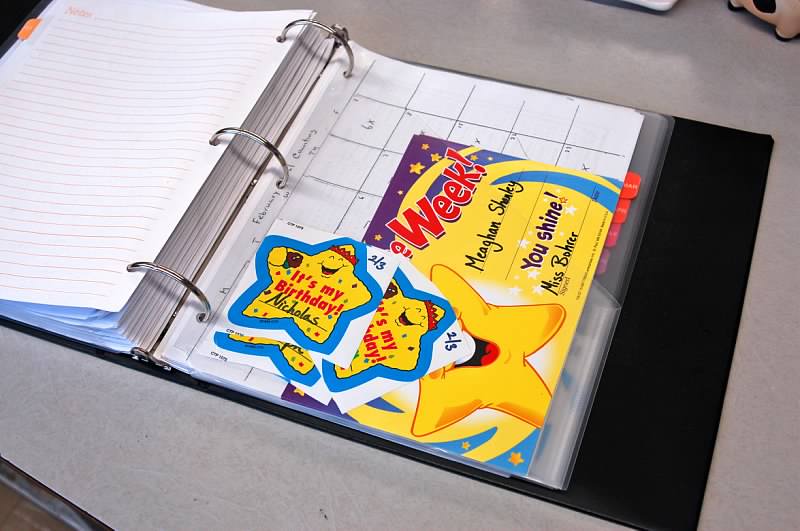
Birthday Certificates
Erica Bohrer: Add a clear sleeve for each month to your teacher binder for birthday certificates. That way, you can assemble them all at one time so you're not scrambling at the last minute.


Parent Handbook Flipbooks
Just Reed: I absolutely love this flipbook. It includes all of the information that parents need, and it's fun and colorful! You can find the link to the printable here, which includes directions, 40 page titles, and perfectly spaced and customizable templates.


School Forms Checklist
Ginger Snaps: Here's a great parent resource for the first day of school. Send home an envelope with all of the forms that parents need to fill out and return to school, and attach a checklist on the front so that parents make sure they send all of it back. I couldn't find you a printable, but I found a link to the TPT store, which is amazing! She also has an amazing collection of pictures from her classroom. 


Lost and Extra Supplies Labels
Kindergarten Works: We all love it when students bring us treasures, but at some point, you just want your students to be able to figure out where things go and put them there. Grab these FREE lost and extra supply labels here, slap them on some buckets, and let the student responsibility begin.


Door Sign
Crib Tales Photography: I found this amazing classroom (or maybe school?) door, but I have no idea where the school is located. I think it's a fantastic idea to use something like this to remind students that they are responsible for their own choices.


Color-Coded Workbooks
A Cupcake For the Teacher: If your students have trouble finding their workbooks in their desks, this might be a solution for you! Grab a marker and swipe it across the sides of the book. Instead of asking students to take out their math workbooks (you know, one of the three that have the same color on the cover),


Too Loud App
iTunes: If the noise level in your classroom gets louder than you'd like, this might be a great app for you. It tracks noise and lets you know just how loud it gets. Turn it into a game and give students a target number.


Homework Checklist
MargD Teaching Posters: If you have a parent checking in homework, here's a great resource for you. You can easily see who has turned in homework, and you can keep these as a homework tracker throughout the year. Eliminate embarrassing charts hung in the classroom! Click here for the FREE printable.


Portable Work Box
Mrs. Walker's Frog-Tastic Website: This website has a great list of procedures to teach in the beginning of the year. I love the idea of having a place for students to turn in their work, especially for those that frequently forget to put their name on their paper. This box would also be easy to transport (lunch room, home, car, etc) if necessary. If you keep a running list of worksheets throughout the week, you can copy one for each student and check off what they've completed and turned in.


Sticky Note Holders
Next To Heaven: You know you've come across a great resource when you come across a resource that you wish you would have come up with yourself. I couldn't find any information on the blog, but I did locate a tutorial for you. Isn't your mind just spinning with ideas for these? Click here for the tutorial.


Common Core Notebooks
Sassy In Second: This is my FAVORITE new resource! I bought these for grades K-5, and I'm using them to organize all of my new common core materials. I'll share some information about how I'm using them soon. These packs come with resources that are great for both students and teachers. My favorite part of them is the standards that are formatted for Avery address labels. You can use them to relabel your worksheets, or as labels for filing folders. Click here to find these notebooks on TPT.


IEP Tracker
School Bells N Whistles: I can't seem to get a good picture of it (or a link to a blog), but this is a fabulous one-page IEP tracker for students. You can keep track of your students' accommodations and modifications all in one place. Click here for the FREE TPT download.

What are some of your favorite finds? Are you implementing new management strategies this year? What small changes have you made that make a BIG difference? We'd love to hear what's working for you!

AFFILIATE LINKS: This post contains affiliate links, which means I receive a small commission if you make a purchase using this link. I purchased all of the items myself, and all of the opinions expressed here are my own.

Thursday, April 18, 2013

STAR Testing Workshops

STAR testing is right around the corner for us California folks, and for those of you in LBUSD, testing begins the week of April 29th. If you do the math on that one, it's 11 days from today! Students will spend 2 weeks taking the English Language Arts and math portions (and other tests depending on what grade they are in, see that schedule here) and 1 week making up missed portions of the test, if needed.

This year, we are offering grade level workshops to help our students review concepts, preview practice questions, learn test-taking strategies, and build confidence. Each workshop spans 2 weekends and includes 4 total hours of instruction. We have gathered some of the best strategies from teachers, administrators, and district personnel throughout the district to put together a fun, interactive, confidence-building workshop series. Many of the strategies that students will learn in this workshop can also be used for in-class tests as well.

My absolute favorite part of this workshop is the parent resources. It sounds completely boring, and you're probably thinking that means some photocopied and stapled informational letters about the exams, some flashcards that are cut crooked and totally boring (that you'll never use), and a list of links that you can visit for more information. Parents will receive a goody bag full of all kinds of wonderful ideas, including but not limited to, breakfast bags, encouraging notes to slip into students' pockets, and exercise ideas that parents can do with their children at home in the morning or on the way to school. Are you intrigued yet? To see snapshots of the materials being made, follow us on Instagram @kidsunderconstruction.

STAR tests can be overwhelming for students and anxiety-inducing for parents, but we're here to help turn these standardized tests into celebrations of knowledge. We hope you will either join us on forward this information to someone that can. For more information, or to register, visit our website here.

Monday, January 14, 2013

Place value with base ten blocks

How many of you are obsessed with the new common core standards like I am? I think they're so wonderful, and I can't wait until they are fully integrated into our curriculum in 2014. Yes, I packed my dork card in my wallet today.

One reason I'm so excited about them is because they offer so many opportunities for our youngest students to build foundational math skills. These skills, such as understanding place value, rounding, math facts, and estimating, are necessary prerequisites for understanding algebra concepts later in their math careers. Math is like a toolbox; beginning students collect tools, intermediate students learn which tools to use when and why, and advanced students must determine which of these tools to use on their own. More often than not, students discover that there is more than one way to figure out a math problem. And that's JUST how math is supposed to be!

One of the most important foundational skills is understanding place value. The value of a digit changes depending on the place that it is in. For example, the digit 4 is worth 4 if placed in the ones place, but it's worth 400 if the 4 is placed in the hundreds place. This fundamental idea helps students with number concepts later on. What I've found is that students struggle with other concepts, such as 2 digit times 2 digit multiplication and rounding, when they don't fully understand place value.

The first step in understanding place value is to practice making 2 digit numbers with base ten blocks. To do this, I bring out some of my favorite "toys" from elementary school. Do you remember these?


The ones that I use are green and made of foam, but I remember having the blue plastic ones in school. Most students now use foam ones because they're much quieter. To practice making 2 digit numbers, students start by rolling the tens dice and placing that number of ten sticks on their work mats in the tens column. Then, they roll the ones dice and place that number of ones cubes on their work mats in the ones column. We practice counting the tens by tens, and we practice counting the ones by ones. On a whiteboard, we also practice writing out the number in word form and expanded form. And if you really want to get fancy with it, you can even have students practice doubling the number.

My favorite game to play for place value is with a deck of cards. I draw two cards from the deck, and make a 2 digit number. I model how I place the larger digit in the tens place because the tens place makes the digit worth much more than it would be worth in the ones place. I then let the student draw two cards to watch them make a 2 digit number. Once they have the hang of it, we keep adding places until we get to the thousands period. For my fourth and fifth grade students, we work into the millions place. It's fun for them to try to beat my number, and to kick it up a notch, I let them take all of their cards and reorder them to make the largest number that they can.

What math games do your students like?

Wednesday, October 31, 2012

BIG ANNOUNCEMENT: group tutoring starts Monday, November 26th!

I know that you've all been waiting for the big announcement, so here it is: Kids Under Construction will be offering group tutoring beginning Monday, November 26th!


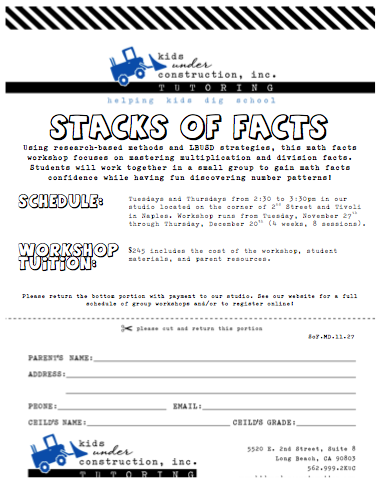
This has been YEARS in the making, and I'm so excited that we are finally offering these workshops to students that need the help. Starting the week after Thanksgiving, we will be offering two different math facts workshops that run for 4 weeks. Each workshop will have 8 sessions, and students will be doing a variety of fun and effective research-based activities to help them master their basic math facts. Although the workshops are geared for grades 1-3 (addition and subtraction) and grades 3-5 (multiplication and division), students of all ages are invited to register.

Over the past 4 years, I have seen the curriculum that challenges students most. I've been collecting a "toolbox" of resources that I knew I'd use for groups later. Well, later is now, and I'm so so excited for them.

In addition to math facts camps, we will also be offering science enrichment, reading comprehension, and writing workshops, just to name a few. Stay tuned for promotions and updates! To see a schedule of workshops being offered, visit our website here.

I'd love it if you all could help me spread the word...hope to see some of you there!

Monday, October 29, 2012

Math Facts Jenga

Here in Long Beach, there's a huge emphasis on math facts. The students take timed tests as early as first grade, and by second grade, students are expected to complete 70 addition problems in under 5 minutes. I'm sure this isn't a whole lot different than in other districts since knowing your math facts is such an important foundational skill.

Math facts can be fun, and we try to share our love for them with our students. Last year, I finally got around to making this. Each block has one addition, one subtraction, one multiplication, and one division fact on it. It's a fun way for students to review whatever facts they are working on, and there are so many different ways that you can play. I usually play one-on-one with my students, so I try to give them incentives. If they miss less that 5 facts, or if they catch 5 or more of my "silly mistakes" they get a sticker or stamp. Sometimes I also make the loser (the one that knocks the tower over first) answer all of the math facts on the blocks that fell over. 


Another fun thing to do is have the students match facts that have the same answers. For example, they might match 9+3 with 6x2, or 8-6 with 18/9.

How do you review math facts with your students?